对 TDD 不了解的同学可参考 Test-driven development
本文使用的 Objective-C 单元测试框架是 OCUnit ,最新的 Xcode 已经包含。
TDD 的步骤如下:
- 写一个测试某个功能的单元测试用例;
- 运行,测试失败;
- 编码实现功能;
- 运行单元测试,通过修改代码,直到测试成功;
- 重构代码;
- 重构单元测试用例;
- 重复 1。
其中 5、6 是可选步骤,有必要了才会进行,但是必须保证产品代码和单元测试用例不能同时被更改。
简单的例子
实现一个很简单的储蓄账户管理。
创建项目
TddDemo (iOS Window-based Application).
Xcode 模版会缺省生成一个 TddDemo 的 target,这个是在 simulator 上跑的,我们需要添加新的 target Test,菜单 project -> new target -> Cocoa -> Unit Test Bundle。具体设置可参考这篇博文。
测试 Case
创建类 _SavingAccountTest, target 选择 Test。
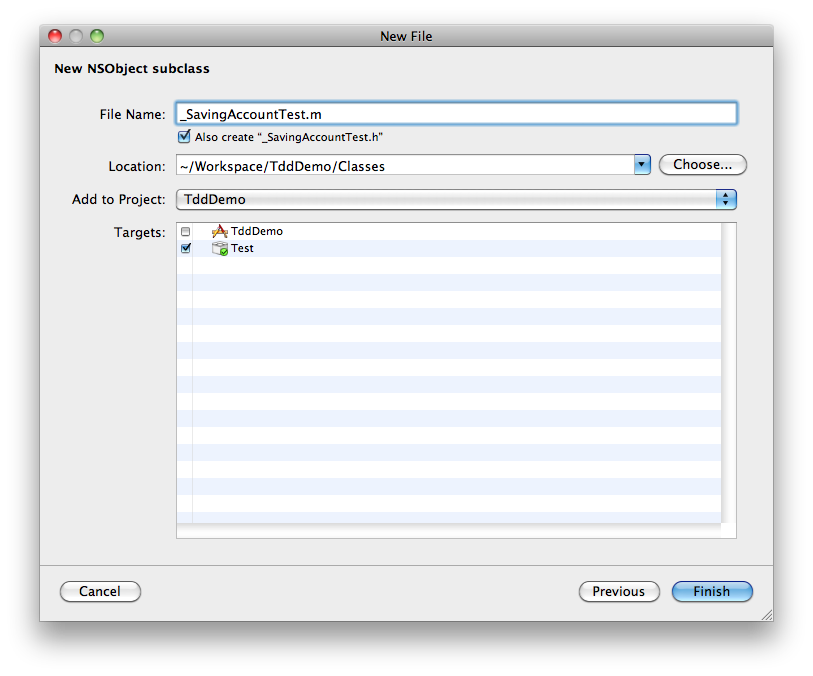
使用 OCUnit 需要 import 头文件 SenTestingKit.h, 并继承 SenTestCase,测试方法名必须以 test 开头。
代码如下: 我们需要可以存钱。
    // _SavingAccountTest.h
    #import < foundation /Foundation.h >
    #import < sentestingkit /SenTestingKit.h >

    @interface _SavingAccountTest : SenTestCase {

    }
    @end

    // _SavingAccountTest.m
    #import "_SavingAccountTest.h"

    @implementation _SavingAccountTest

    - (void)testDeposit {
        SavingAccount *account = [[SavingAccount alloc] init];
        [account deposit:100];
        STAssertEquals(100, [account balance],
                       @"bad balance 100 != %d", [account balance]);
        [account release];
    }

    @end
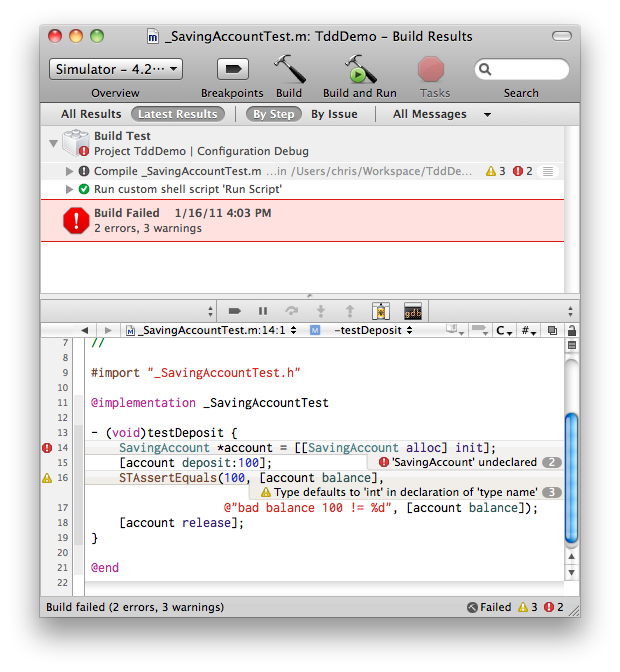
运行,测试失败
功能实现
最简单的方式让测试通过。
    // SavingAccount.h
    #import < foundation /Foundation.h >

    @interface SavingAccount : NSObject {

    }

    - (void)deposit:(int)money;
    - (int)balance;

    @end

    // SavingAccount.m
    #import "SavingAccount.h"

    @implementation SavingAccount

    - (void)deposit:(int)money {

    }

    - (int)balance {
        return 100;
    }

    @end
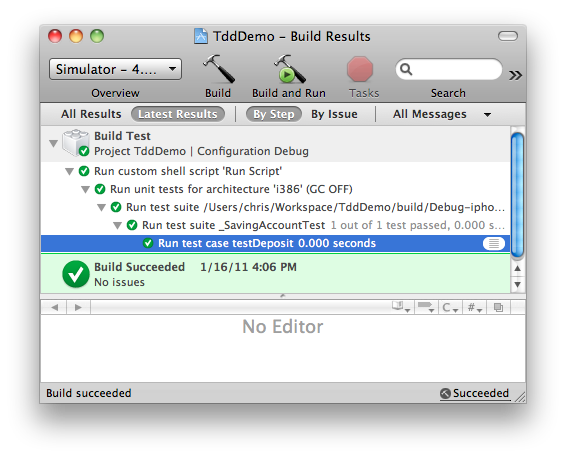
运行,测试成功
下一个 Case
那么如果取钱会怎样?
修改 testDeposit 函数为如下:
    // _SavingAccountTest.m
    - (void)testDepositAndWithdraw {
        SavingAccount *account = [[SavingAccount alloc] init];
        [account deposit:100];
        [account withdraw:50];
        STAssertEquals(50, [account balance],
                       @"bad balance 50 != %d", [account balance]);
        [account release];
    }
然后在 SavingAccount 添加空方法 withdraw 使编译通过。
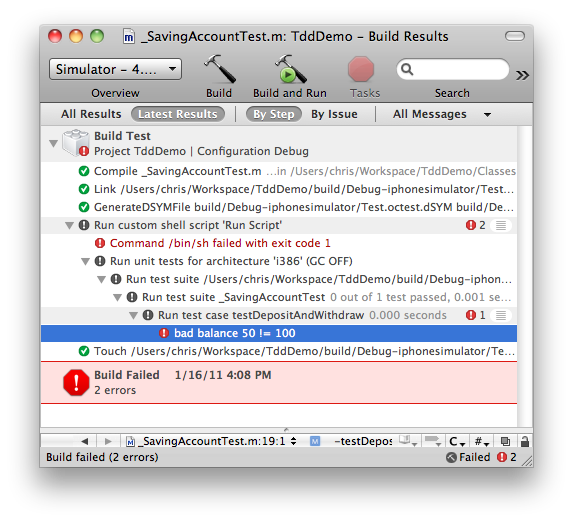
运行,测试失败
功能实现
SavingAccount interface 添加属性 balance,更改实现如下
    // SavingAccount.m
    - (void)deposit:(int)money {
        balance += money;
    }

    - (void)withdraw:(int)money {
        balance -= money;
    }

    - (int)balance {
        return balance;
    }
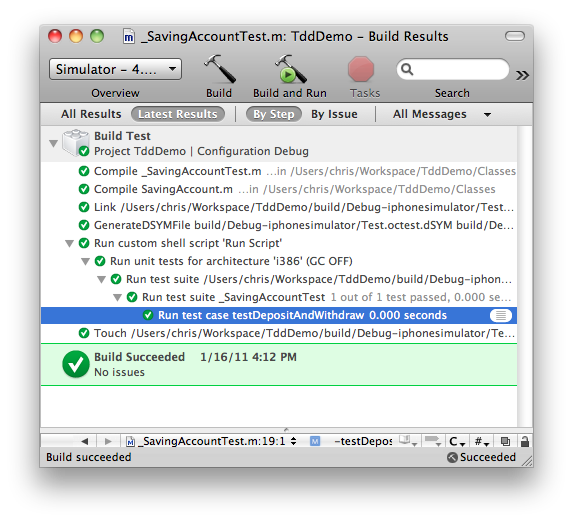
运行,测试成功
新 Case
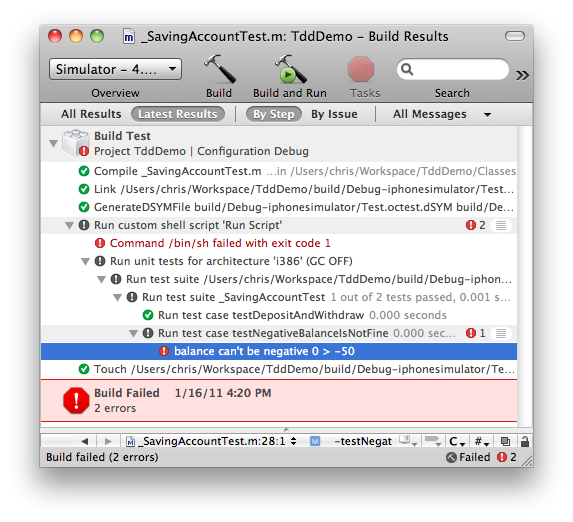
银行存款账户不能透支, 添加 testNegativeBalanceIsNotFine:
    // _SavingAccountTest.m
    - (void)testNegativeBalanceIsNotFine {
        SavingAccount *account = [[SavingAccount alloc] init];
        [account deposit:50];
        [account withdraw:100];
        STAssertEquals(0, [account balance],
                       @"balance can't be negative 0 > %d", [account balance]);
        [account release];
    }
运行,测试失败
更改实现
    - (void)withdraw:(int)money {
         balance -= money;
         if (balance < 0) {
            balance = 0;
         }
    }
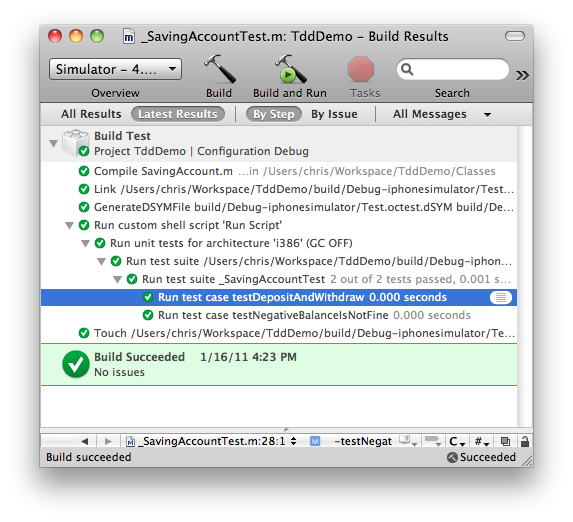
运行,测试成功
重构
这时我们会发现测试的两个 case 里面都要实例化一个 SavingAccount, 是重复代码,可以提取出来,放入 setUp 和 tearDown 中,这两个方法分别在每一个 test 的最早和最后执行。
    // _SavingAccountTest.m
    - (void)setUp {
        account = [[SavingAccount alloc] init];
    }

    - (void)tearDown {
        [account release];
    }
运行,测试成功
继续 …
UT 和 TDD
- 人月神话很早以前就说过 No, silver bullet,TDD 也是
- UT 是需要时间成本的,所以要考虑 ROI (Return on Investment), 有些场景比如 UI 交互单元测试成本很高,就可以不去做,但大多数场景下,只要做 UT,总是会有很好的 ROI 的
- 切记切记不要追求覆盖率,但至少每个 bug 都要用 UT 覆盖